EU AI Act Technical Documentation: What Annex IV Requires for Enterprise AI | JP Márquez
· 12 min read
By Juan Pedro Márquez
📋 Quick Reference
Audience: CISOs, Compliance leads, and IT Directors managing high-risk AI deployments in EU organizations
Time to read: ~12 minutes
What you'll get: A plain-language breakdown of all 7 Annex IV sections — what each requires, what Microsoft provides, and what you must produce yourself
Short answer: Annex IV is the technical file every high-risk AI system must keep: what the system is, how it was built and tested, how it is monitored and controlled, how risk is managed, and how it is watched after deployment. Microsoft supplies part of it. The deployment-specific evidence is yours.
Your legal team just handed you a report on EU AI Act compliance. You read the executive summary. Three bullet points. None of them tell you what you need to actually produce by August 2.
Here is what they missed: Annex IV technical documentation is not a policy document. It is a living technical record. And the gap between what most enterprises currently have and what regulators will ask for on August 2 is wider than most IT leaders realize.
Why Technical Documentation Is the Core Compliance Obligation
The EU AI Act's compliance architecture centers on documentation. Unlike frameworks that rely primarily on audits or testing, the EU AI Act expects organizations to maintain continuous documentation of their AI systems — documentation that authorities can review on request, without warning.
This documentation serves three functions that most IT leaders underestimate:
- Evidence of compliance: Demonstrates that you assessed risks, implemented governance, and established human oversight before deploying
- Audit trail: Shows how the AI system evolved over time and what changes were reviewed
- Foundation for conformity: For systems requiring third-party assessment, the documentation is the starting point — not the output
The critical distinction nobody tells you: A slide deck titled "AI Governance Framework" is not Annex IV documentation. A vendor's product brochure is not Annex IV documentation. A one-page risk summary written by Legal is not Annex IV documentation. Annex IV is a technical record requiring specific content across 7 defined sections — and it must be maintained throughout the system's lifecycle.
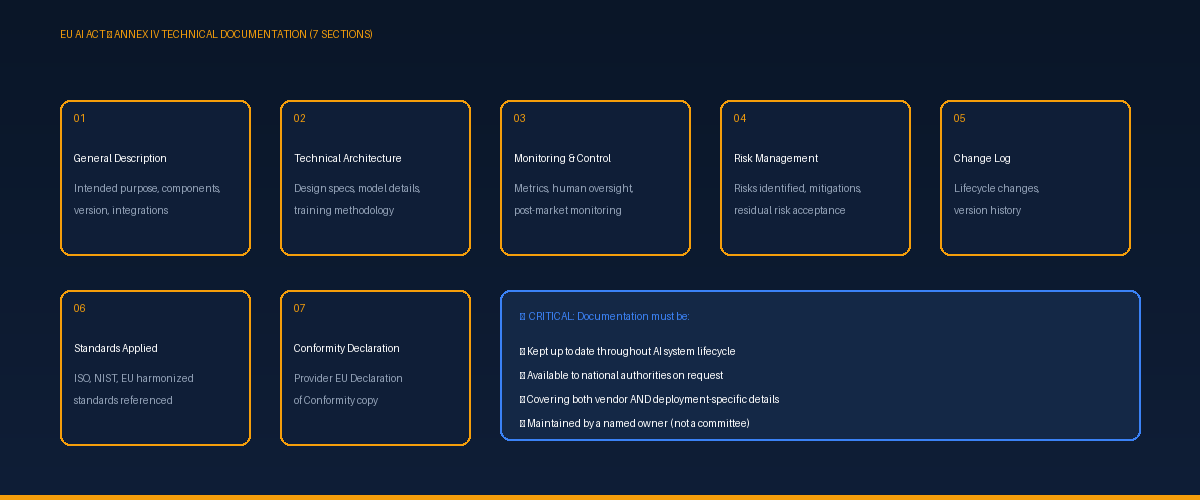
The 7 Annex IV Sections: What Each Actually Requires
Section 1: General Description of the AI System
This is the most accessible section — and the one most often done wrong. A "general description" under Annex IV is not a marketing overview. It must include: the intended purpose (specific, not generic), all system components including software and relevant hardware, the version and associated product, how the system interacts with other systems, and instructions for use.
For Microsoft deployments, the Azure AI Transparency Notes provide the model-level general description. What you must add: the specific service, in what configuration, connected to what data sources, for what precise business purpose in your organization.
A compliant entry looks like: "Azure OpenAI Service (GPT-4o via Copilot Studio), deployed as an HR policy FAQ agent, connected to internal SharePoint knowledge base, accessible to all employees via Microsoft Teams. Intended purpose: respond to employee queries about company HR policies. Not designed to make or inform employment decisions."
Section 2: Detailed Description of Technical Architecture
This section goes deeper: design specifications, overall system logic, key architectural choices, training methodology if applicable, and how software components interact. For standard Copilot deployments, much of this is covered by Microsoft's published documentation on model architecture.
Your deployment-specific documentation should focus on: what plugins or extensions are enabled, what data connectors are configured, what access controls and permissions apply, and any customizations or prompt engineering applied.
For custom Azure AI deployments, refer to Azure OpenAI Service documentation as the technical foundation, then document your specific configuration and customization choices.
Section 3: Monitoring, Functioning, and Control
This is the section most directly tied to Article 14 (human oversight). It must cover: what metrics are monitored, who reviews monitoring outputs, what triggers a review or remediation action, the retention period for audit logs, and how humans can intervene or override the system.
Azure Monitor and Microsoft Purview provide the monitoring infrastructure. Your documentation must describe the process that uses this infrastructure — who watches the dashboards, what an anomaly triggers, and how fast a human can intervene.
Section 4: Risk Management System Documentation
This is the section that cannot be borrowed from Microsoft's documentation. The risk assessment for your specific deployment — what risks exist in your business context, to which employees or customers, under what conditions — is yours to produce.
A CV screening agent in a logistics company has different risks than the same technology in a healthcare organization. The risk management documentation must reflect your deployment context. The Microsoft Responsible AI Impact Assessment Guide provides a methodology framework — the assessment itself is your work.
Section 5: Change Log
A change log documenting significant modifications over the AI system's lifecycle, including whether a new conformity assessment is required after each change. For Microsoft-managed services, model updates are deployed by Microsoft — your change log should capture these alongside your own configuration changes.
Establish a process to review Azure AI service release notes regularly and assess whether updates affect your compliance documentation. This is a process gap in almost every enterprise I've worked with.
Section 6: Standards and Specifications Applied
A list of harmonized EU standards, common specifications, or other technical standards applied to the AI system. For Microsoft AI services, the relevant standards are documented in Microsoft's compliance documentation. Relevant references include ISO/IEC 42001 (AI Management Systems) and the NIST AI Risk Management Framework.
Section 7: EU Declaration of Conformity
For systems subject to conformity assessment, a copy of the EU Declaration of Conformity signed by the provider. For most Microsoft AI services, Microsoft as the provider will supply this. Your task: obtain it, file it in your governance repository, and verify it covers the specific service and version you are deploying.
Three Documentation Failures to Avoid
- Relying solely on vendor documentation. Microsoft's Transparency Notes document the model, not your deployment. File them as annexes — produce your deployment documentation as the main record.
- Static documentation that doesn't reflect current state. Assign documentation maintenance to a named owner with a quarterly review cadence. Documentation produced in 2025 that doesn't reflect a 2026 configuration change is a compliance gap.
- No process for Microsoft update reviews. Microsoft updates Azure AI models regularly. Some updates materially change model behavior. Without a defined process to review release notes and assess documentation impact, your Annex IV record will drift out of date silently.
A Practical Annex IV Template Structure
Use this structure for each high-risk AI deployment in your organization:
| Section | Content Required | Primary Source |
|---|---|---|
| 1. General Description | Purpose, components, version, integrations, instructions | You + Microsoft Transparency Note |
| 2. Technical Architecture | Design specs, model details, configuration, access controls | You + Azure AI documentation |
| 3. Monitoring & Control | Metrics, oversight procedures, override mechanisms, retention | You (using Purview/Monitor) |
| 4. Risk Management | Risks identified, mitigations, residual risk acceptance | You (deployment-specific) |
| 5. Change Log | Version history, configuration changes, model updates | You + Azure AI release notes |
| 6. Standards Applied | ISO, NIST, EU harmonized standards referenced | You + Microsoft compliance docs |
| 7. Conformity Declaration | Provider EU Declaration of Conformity copy | Microsoft (request from vendor) |
Where to start if you have zero documentation today:
1. Complete Section 1 (General Description) for each high-risk system — fastest section, establishes scope
2. Pull Microsoft Transparency Notes for relevant services and file as annexes
3. Assign Section 4 (Risk Management) to a joint IT/Legal workstream — most time-intensive, most organization-specific
4. Establish the change log process before you do anything else — it's the only section that requires ongoing discipline from day one
Frequently Asked Questions
Does Microsoft provide the Annex IV technical documentation for me?
Partially. Microsoft supplies provider-level material — transparency notes, model cards, security and privacy documentation — that you cite as evidence. But Annex IV describes your deployment: your use cases, your risk assessment, your human oversight. The provider layer is an input, not the finished deliverable.
How long does Annex IV documentation need to be?
There is no page count. The test is sufficiency — can a regulator reconstruct how your system works, what risks you assessed, and how you control them? A focused, accurate ten-page record beats fifty pages of boilerplate. Write for an auditor who knows nothing about your environment.
We have good governance but little written down. Are we compliant?
No. Under an evidence-based framework, undocumented governance is unprovable governance — and unprovable means non-compliant. The reverse is worse: documentation describing controls you don't actually run is misleading. Documentation and day-to-day practice have to match.
How often does the technical documentation need updating?
Treat it as living. Material changes — a new use case, a model upgrade, a revised risk assessment — should trigger an update, with the change and date recorded. Versioning discipline from day one is far cheaper than reconstructing a year of changes the week before an audit.
Documentation Is the Proof That Your Governance Is Real
Technical documentation is necessary but not sufficient for EU AI Act compliance. Organizations that have documentation but no actual risk management process are still non-compliant. But organizations with excellent governance and no documentation are also non-compliant — because they cannot demonstrate their compliance to regulators.
In a regulatory framework built around evidence, documentation is not bureaucracy. It is the proof that your governance program exists.