EU AI Act AI Governance Owner: How to Appoint and Define the Role | JP Márquez
· 10 min read
By Juan Pedro Márquez
📋 Quick Reference
Audience: CISOs, CDOs, and IT Directors responsible for formalizing AI governance before the EU AI Act August 2 deadline
Time to read: ~10 minutes
What you'll get: Four concrete role patterns for AI governance ownership, a mandate design framework, and a 4-week implementation plan
I've asked this question to IT and compliance leaders across EMEA: "Who in your organization owns AI compliance?"
Every single answer named a committee. A working group. A shared responsibility between Legal, IT, and Compliance. And that answer — however well-intentioned — is precisely why most organizations won't be ready on August 2, 2026.
Here's the thing about committee ownership: a committee cannot be held accountable. A committee cannot sign a Declaration of Conformity. A committee cannot report a serious AI incident to a national authority within 15 days. A committee cannot be named in a regulatory investigation as the responsible party.
The EU AI Act requires deployers to implement "appropriate organizational measures" to fulfill their obligations under Article 29. What that means in practice — even if the regulation never says it explicitly — is a named human being who owns this.
What the EU AI Act Actually Requires on Governance
Article 29 places specific obligations on deployers that require organizational accountability. You must ensure AI systems are used in accordance with the provider's instructions, implement human oversight measures, establish post-market monitoring, and report serious incidents to authorities within 15 days.
Each of these obligations has a decision latency. Incident reporting has a 15-day clock that starts the moment you become aware of the incident. Human oversight requires defined roles who can intervene in near-real-time. Post-market monitoring requires someone who reviews telemetry regularly — not when it comes up at the quarterly steering committee.
The accountability test: Pick any high-risk AI system in your organization. Ask: if this system produces a discriminatory output that harms an employee tomorrow, who gets the call at 8am? Who makes the decision about escalation? Who signs the regulatory notification? If you cannot name a single person for each of those questions — you don't have governance ownership, you have governance ambiguity.
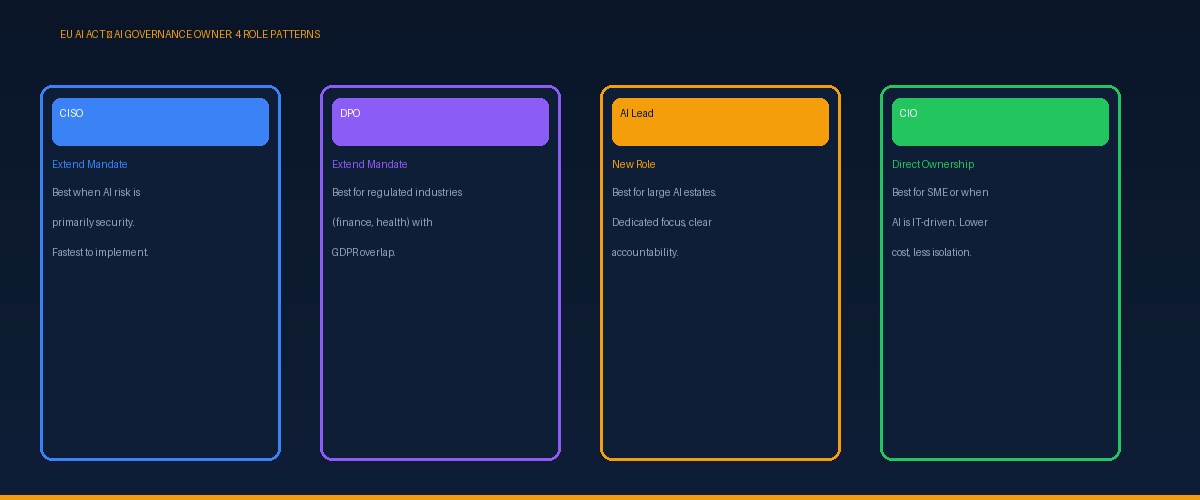
Four Role Patterns That Work
The right AI governance owner depends on your organization's structure, risk profile, and AI estate. There is no universally correct answer — but there are four patterns that consistently work.
Pattern 1: Extend the CISO's Mandate
Best for: Organizations where AI risk is primarily security and data privacy risk. Works well when the AI estate is primarily Microsoft 365 Copilot and Azure AI services — because the CISO already owns adjacent domains.
The CISO already manages data protection, access controls, incident response, and vendor security assessment. Extending their mandate to include AI governance adds a new domain but builds on existing processes, existing relationships with Legal and Compliance, and existing tooling.
For Microsoft environments, this integration is natural: Microsoft Purview, Microsoft Defender for Cloud, and Microsoft Sentinel already sit in the CISO's stack. This is the fastest integration path to a functioning governance role.
What changes: The CISO's charter must explicitly include EU AI Act compliance. Their team needs AI governance competency — either through hiring, training, or a dedicated AI governance lead reporting to the CISO.
Pattern 2: Extend the DPO's Mandate
Best for: Organizations in heavily regulated industries — financial services, healthcare, insurance — where AI governance overlaps significantly with GDPR compliance. Organizations that already have a strong, technically-capable DPO function.
The Data Protection Officer role has deep overlap with AI governance: data processing accountability, impact assessments, rights of individuals affected by automated decisions. Creating a unified "data and AI governance" function under an expanded DPO mandate avoids duplication and builds on established regulatory relationships.
What changes: The DPO needs technical AI competency, not just legal and privacy expertise. This may require a senior technical AI governance lead in their team. The DPO charter must be updated and approved at board level — this is not an informal extension.
Pattern 3: Create a Dedicated AI Governance Lead
Best for: Organizations with significant AI investment across multiple business units. Organizations where AI is a core competitive differentiator and governance complexity justifies dedicated focus.
A dedicated AI Governance Lead provides focused ownership without competing with other governance priorities. In organizations where this works well, the role sits at senior manager or director level, reports to the CISO or CDO, and integrates with existing governance bodies (Risk Committee, IT Steering Committee).
Practical reality: In most mid-size enterprises, this role starts as a 0.5 FTE expansion of an experienced IT governance manager's remit, and becomes a dedicated role as the AI estate grows. Don't wait for the AI estate to grow before appointing someone — appoint first, scale the mandate as needed.
Pattern 4: CIO Direct Ownership
Best for: Organizations where AI is primarily an IT-driven capability. Smaller organizations where dedicated headcount is not feasible in the near term.
The CIO takes direct accountability for AI governance, with execution delegated to an IT governance team member. This works when the CIO has the technical depth to engage with AI risk questions directly — and when their objectives include AI governance outcomes as a measured result.
What changes: The CIO's objectives and performance metrics must include AI governance outcomes. Without measurement, accountability is nominal.
The Five Areas Every AI Governance Owner Must Cover
Regardless of who holds the role, the AI governance owner's mandate must cover these five areas:
- AI Inventory Ownership: Maintain the complete AI inventory with risk classification and documentation status. Review quarterly. New AI deployments notify the governance owner before production.
- Risk Assessment Oversight: Ensure risk assessments are completed for all high-risk deployments. Escalate to Legal when assessments identify unresolved issues. Leverage Azure ML Responsible AI Dashboard for model-level assessments.
- Documentation Maintenance: Maintain the central AI governance repository. Ensure Annex IV documentation is current. Establish a monthly process to review Azure AI release notes for documentation impact.
- Incident Response: Define what constitutes a reportable AI incident. Own the 15-day notification workflow. Test the procedure at least annually. Integrate with Azure Monitor alerts.
- Regulatory Engagement: Primary contact for national supervisory authorities. Must know where every document is, who produced it, and how current it is. Leverage Microsoft Compliance Manager for ongoing compliance posture tracking.
Four Weeks to a Functioning Governance Role
| Week | Action | Output |
|---|---|---|
| Week 1 | Executive sponsor decision and formal appointment | Named owner with board-level endorsement |
| Week 2 | Charter drafting: mandate, reporting line, authority, resources, metrics | Governance charter approved by sponsor |
| Weeks 2–4 | Initial AI inventory under governance owner's leadership | Complete classified AI inventory |
| Week 4 | Tool access setup: Purview, Defender for Cloud, Azure Policy, Compliance Manager | Governance owner operational in the toolstack |
| Week 4 | Organization-wide communication from executive sponsor | All business units know the AI governance process |
The single most common failure: Appointing a governance owner without giving them authority over business unit AI deployments. If the governance owner cannot stop a business unit from deploying a high-risk AI system without review, the governance program is advisory — not operational. Authority must be explicit in the charter and communicated from the executive sponsor.
Frequently Asked Questions
Does the EU AI Act require a specific job title for AI governance?
No. The Act mandates accountability, not a named role — it never prescribes a "Chief AI Officer." What it requires is that someone with real authority owns risk management, documentation, and oversight. The title is yours to choose. The accountability is not optional.
Can a committee own AI governance instead of an individual?
A committee can advise, but it cannot be accountable. Regulators need one name to hold responsible. Distributed ownership becomes nobody's ownership the moment an audit asks who approved a decision. Name an individual, give them a mandate, and let the committee support them.
Where should the AI governance owner sit — IT, security, or legal?
It depends on where your AI risk concentrates. Heavily regulated data favours a security or compliance home; productivity-led Copilot rollouts often sit better with IT. What matters more than the box on the org chart is direct executive sponsorship and the authority to enforce policy.
When does this need to be in place?
Before 2 August 2026. The governance role, its mandate, and a started AI system inventory should exist by then — the same deadline driving the Microsoft 365 Copilot compliance plan. You don't need a finished program — you need a named owner and demonstrable progress. Standing up the role the week of the deadline is already late.
Name the Owner. Define the Mandate. Build the Inventory.
In that order. Before August 2.
A governance program that lives in a committee will not survive contact with a regulatory audit. A governance program owned by a named individual with a clear mandate, access to the right tooling, and organizational authority to enforce policy — will.
The EU AI Act doesn't mandate a specific job title. It mandates accountability. Make accountability specific.