EU AI Act Enforcement Date 2026: Enterprise IT Compliance Guide | JP Márquez
· 9 min read
By Juan Pedro Márquez
📋 Quick Reference
Audience: Enterprise IT Directors, CISOs, and Compliance leads deploying AI in EU-regulated environments
Time to read: ~9 minutes
Skill level: Intermediate
What you'll get: A clear breakdown of August 2, 2026 obligations, the five core requirements, and a practical compliance checklist for Microsoft environments
The countdown is real. On August 2, 2026, the EU AI Act reaches its most consequential enforcement milestone — the day when full obligations for high-risk AI systems become applicable across all EU member states.
If your organization deploys AI in HR decisions, credit scoring, critical infrastructure, or any of the 8 high-risk categories defined in Annex III, you have a legal obligation to be compliant. This is not a guideline. It is European law, with fines of up to 3% of global annual turnover — and up to 7% for the most serious violations.
The EU AI Act Timeline: Where We Are
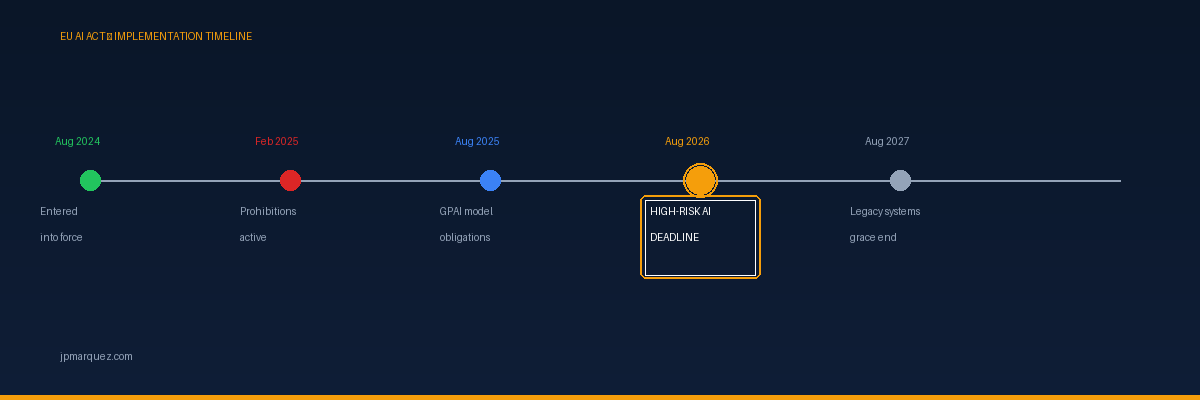
The regulation entered into force on August 1, 2024, with a phased implementation designed to give organizations time to adapt:
- February 2, 2025 — Prohibitions on unacceptable-risk AI activated: social scoring by public authorities, real-time biometric surveillance in public spaces, AI exploiting psychological vulnerabilities
- August 2, 2025 — Obligations for general-purpose AI model providers (GPT-4, Claude, Gemini) took effect
- August 2, 2026 — Full obligations for high-risk AI deployers — the critical enterprise deadline
- August 2, 2027 — Additional obligations for certain legacy high-risk AI systems already on market
The August 2026 date affects the vast majority of enterprise AI deployments. This is the moment when the compliance work you have — or have not — done becomes auditable.
Which AI Systems Are High-Risk?
The regulation defines high-risk AI in Annex III, covering 8 categories that enterprise IT leaders must assess:
- Biometric identification — remote identification, emotion recognition, biometric categorization
- Critical infrastructure — water, gas, electricity, digital infrastructure management
- Education — AI determining access or evaluating learners
- Employment — CV screening, performance monitoring, promotion and termination decisions
- Essential services access — credit scoring, insurance risk, social benefits eligibility
- Law enforcement — crime prediction, evidence evaluation (heavily restricted)
- Migration — risk assessment, document authentication
- Administration of justice — AI assisting judicial fact-finding
Key insight for Microsoft environments: Standard Microsoft 365 Copilot for productivity (email, Teams, Word) is typically minimal risk. The category that requires careful enterprise assessment is employment/workforce management — any AI touching HR processes, performance evaluation, or hiring decisions.
The Five Core Obligations That Activate in August 2026
The EU AI Act is not a checkbox exercise. It establishes a quality management system for AI — similar in structure to ISO 9001 but specific to AI risk. Here are the five obligations that high-risk AI deployers must fulfill.
1. Risk Management System (Article 9)
You must establish, implement, document, and maintain a risk management system throughout the entire AI lifecycle. This means identifying foreseeable risks, estimating and evaluating them, adopting mitigation measures, and testing residual risks.
This is an ongoing obligation, not a one-time assessment. For Microsoft customers, Azure AI Foundry's responsible AI capabilities provide tooling for model risk evaluation — your task is to document the deployment-specific risk assessment on top of that foundation.
2. Data and Data Governance (Article 10)
High-risk AI systems must have documented data governance practices covering collection, labeling, storage, filtering, and bias mitigation. For Microsoft deployments, Microsoft 365 Copilot privacy documentation covers the vendor-side data governance. Your organization must document the layer on top — what data you provide, how you govern it, and how you ensure it is free from discriminatory bias.
3. Technical Documentation (Article 11 + Annex IV)
This is the compliance gap I see most frequently. Organizations assume that because they're deploying a compliant vendor's AI, the technical documentation falls entirely on the vendor. It does not.
Deployers must maintain Annex IV documentation for each high-risk deployment: general description, technical architecture, monitoring and control procedures, risk management records, change log, standards applied, and the provider's EU declaration of conformity. Microsoft's Transparency Notes form the vendor component — you supplement with your deployment specifics.
4. Human Oversight (Article 14)
High-risk AI must be deployed with effective human oversight: the ability to understand the system's limitations, disregard or override AI outputs, and stop the system when necessary. No high-risk AI system should make final, unreviewed decisions.
Microsoft Purview and Azure Policy provide the infrastructure for documenting and enforcing human oversight in Microsoft environments.
5. Post-Market Monitoring and Incident Reporting (Articles 72–73)
Deployers must establish post-market monitoring procedures and report serious incidents to national authorities within 15 days. You need a defined AI incident response procedure — separate from your general IT incident response — specifying what constitutes a reportable AI incident and who is responsible for regulatory notification.
Azure Monitor and Microsoft Sentinel provide the monitoring infrastructure; your governance team defines the incident threshold and reporting workflow.
Three Failure Patterns to Avoid
After working with enterprise IT teams across EMEA on AI governance, I see the same failure patterns repeatedly:
- Assuming vendor compliance covers you. Microsoft's compliance posture reduces your burden — it does not eliminate it. You are a deployer with independent obligations under Article 29.
- No single governance owner. AI governance by committee produces documentation no one maintains and oversight procedures no one exercises. Appoint a named owner before August.
- Starting documentation too late. Annex IV documentation takes 4–8 weeks to complete for a non-trivial deployment. A slide deck titled "AI Governance Framework" is not Annex IV documentation.
Practical Compliance Checklist for August 2, 2026
| Area | Action | Priority |
|---|---|---|
| Governance | Name AI governance owner with explicit mandate | 🔴 Critical |
| Inventory | Complete AI system inventory with risk classification | 🔴 Critical |
| Documentation | Annex IV technical docs for each high-risk system | 🔴 Critical |
| Oversight | Human override procedures documented and tested | 🟡 High |
| Incident Response | AI-specific incident definition and 15-day reporting workflow | 🟡 High |
| Microsoft-specific | Purview audit logging enabled for Copilot interactions | 🟢 Important |
| Microsoft-specific | Transparency Notes filed for all Azure AI services in use | 🟢 Important |
Key Microsoft resources for EU AI Act compliance:
→ Azure AI Transparency Notes — vendor-level documentation foundation
→ Microsoft Purview — audit logging and data governance
→ Azure Policy — automated governance enforcement
→ Azure ML Responsible AI Dashboard — model risk assessment
→ Copilot Studio Responsible AI — agent governance framework
Frequently Asked Questions
What actually changes on 2 August 2026?
It is the date that obligations for general-purpose AI and the broader governance regime become enforceable, with designated supervisory authorities able to act. It isn't a switch that makes every system illegal overnight — it's the point at which "we're working on it" stops being a defensible position.
Will most Microsoft 365 Copilot deployments be classified as high-risk?
Usually not. Standard productivity use typically falls outside the high-risk categories. The catch is that you need the documentation to prove the low-risk classification — the determination, the reasoning, the evidence. "It's obviously not high-risk" is an argument; a written classification is compliance.
What are the core obligations activating around this date?
They centre on accountability: a current inventory of AI systems, risk classification per use case, technical documentation, human oversight procedures, and incident handling. None of these are technical features you switch on — they are governance practices you have to stand up and be able to evidence.
We've barely started. What's the single highest-value first step?
The inventory. Every other obligation depends on knowing what AI you actually run and where. Start listing systems and use cases now; classification and documentation flow from that. An organization with a real inventory and visible progress is in a far stronger position than one with a polished policy and no map.
Start With the Inventory
August 2 is a hard deadline. National enforcement authorities across EU member states are preparing enforcement capacity — the European AI Office is operational, and member states have designated supervisory authorities.
The organizations in the strongest position on August 2 are those that have treated compliance as a governance program — not a vendor checklist. The classification work determines your burden: most standard Microsoft 365 Copilot deployments will find their AI use falls outside the high-risk category, but you need the documentation to prove it.
I've compiled the risk classification framework, Annex IV documentation templates, and a 30-day compliance sprint guide into a practical pack for enterprise IT teams using Microsoft environments.