From Pilot to Production: A 5-Gate Framework for Microsoft AI Agents
· 11 min read
By Juan Pedro Márquez
A demo agent and a production agent look almost identical in a screen recording. They are not the same system. The demo has to work once, for a friendly user, on a good day. The production agent has to work the ten-thousandth time, for a hostile user, at 2am, when a downstream API is timing out and nobody is watching. Everything expensive about enterprise AI lives in that gap.
Most teams cross it by accident. The pilot goes well, a director says "ship it," and a proof-of-concept gets promoted into production with none of the machinery that production demands. Then it fails in a way that's embarrassing rather than instructive, and the whole program loses a year of trust.
I use a five-gate framework to cross that gap on purpose. Each gate is a question the agent must pass before it earns the next stage. This is written for Microsoft-native agents — Copilot Studio and Azure AI Foundry Agent Service — because that's where I work, and because the generic "LangGraph vs CrewAI" advice you'll find online skips the enterprise controls that actually decide whether an agent survives contact with a real tenant.
Why do most enterprise AI agents stall between pilot and production?
They stall because the pilot optimizes for the wrong thing: a compelling demo. Demos reward open-ended capability and a happy path. Production rewards the opposite — bounded behavior, predictable failure, observability, and identity — none of which show up in a screen recording, so none of them get built. The move from pilot to production isn't more capability; it's adding the reliability scaffolding the demo let you skip.
There's a subtler reason too, and it's a mindset one. Teams treat the agent as a new kind of thing that needs a new kind of process. It doesn't. A production agent is a software application that happens to be non-deterministic. Bake it into the disciplines you already have — CI/CD, identity, monitoring, staged rollout — and add the two or three things that are genuinely new. The five gates are that combined checklist.
Here's the opinion I'll defend: the readiness signal that matters most isn't how smart your agent is. It's how much of what it needs is already deployed and governed in your tenant. An agent that reuses an existing identity model, an existing data boundary, and an existing monitoring stack is a quick win. An agent that needs all of that built from scratch is a program, and you should price it as one.
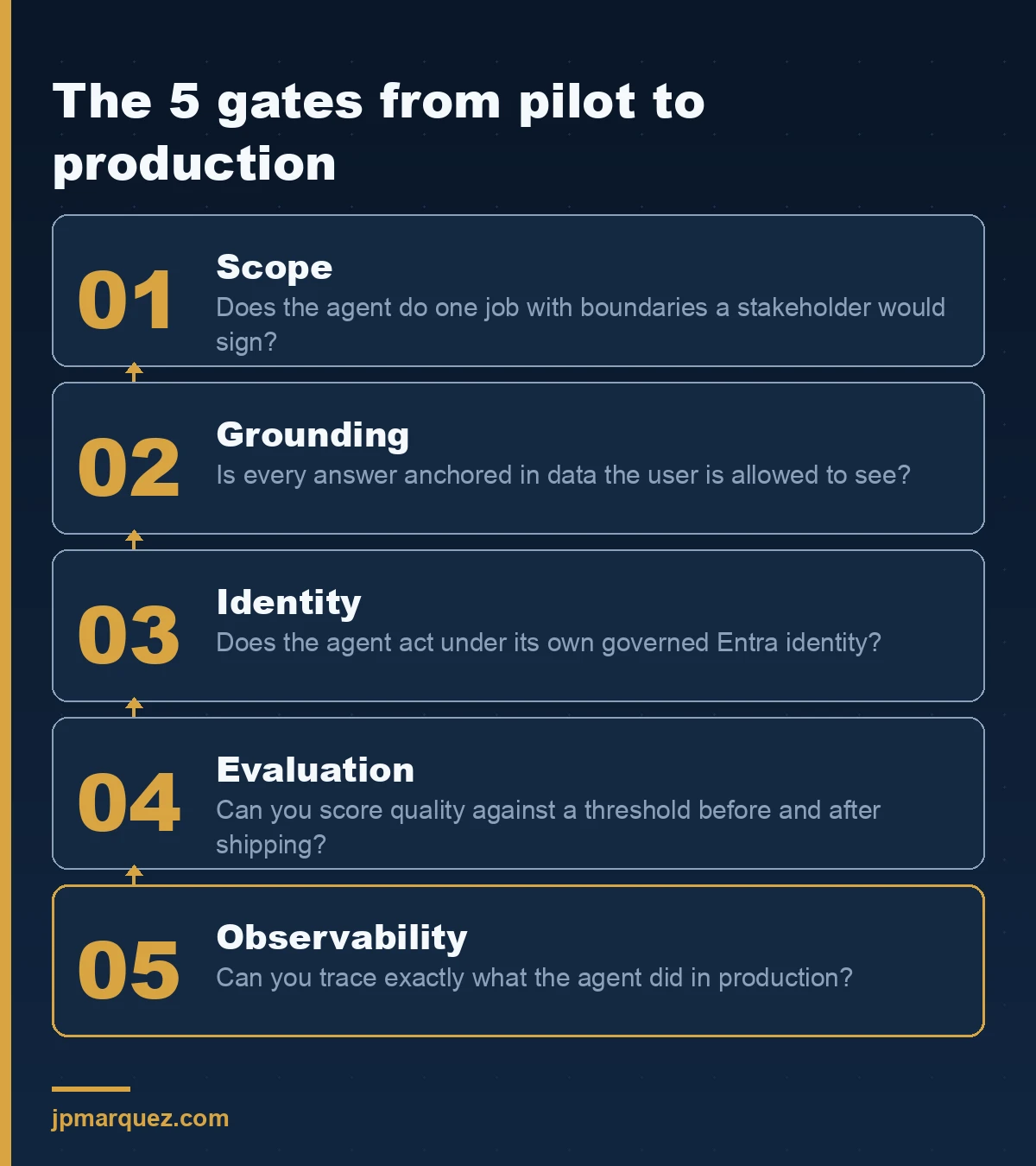
Gate 1 — Is the agent's scope narrow enough to be reliable?
The first gate has nothing to do with technology. It's whether the agent does one job with clear boundaries, or whether it's a general assistant that will be judged against every job it might plausibly do. Narrow agents ship. Broad agents demo well and then disappoint forever, because "answer anything" has no acceptance criteria.
Concretely: define the tasks the agent handles and — more importantly — what it refuses. In Foundry Agent Service, that scoping is expressed through the agent's instructions, its tool catalog, and the guardrails around what actions it can take. In Copilot Studio, it's topics, prohibited subjects, and unknown-intent fallbacks. Model choice belongs at this gate too: Microsoft is explicit that experimental and preview models aren't for production, and you should select a primary model deliberately rather than defaulting to whatever was newest when you started.
The test to pass Gate 1: can you write the agent's job — and its refusals — in three sentences a non-technical stakeholder would sign? If not, the scope is still too wide.
Gate 2 — Is every answer grounded in data the user is allowed to see?
An ungrounded agent is a liability with a friendly interface. Gate 2 asks whether responses are anchored in trusted sources, and whether that grounding respects permissions.
Foundry Agent Service grounds agents through knowledge tools — File Search over Azure AI Search, SharePoint, Fabric, and Blob storage — so answers cite real organizational data instead of the model's imagination. Copilot Studio does the same against sources the user already has permission to open. Two controls make grounding trustworthy rather than just present: Groundedness detection, which flags responses that drift from the source, and — critically — the permission model, so the agent can't retrieve what the person in front of it couldn't retrieve themselves.
This is where a lot of "successful pilots" quietly fail the real test. In the pilot, one admin ran every query, so every document was fair game and grounding looked flawless. In production, a thousand users with a thousand permission scopes hit it, and the question stops being "is the answer grounded?" and becomes "grounded in whose data?" If you haven't validated grounding under real permission diversity, you haven't validated grounding. This is also why the data-governance work — the SharePoint and Purview readiness I keep insisting on — is a prerequisite to this gate, not a parallel track.
Gate 3 — Does the agent have its own governed identity?
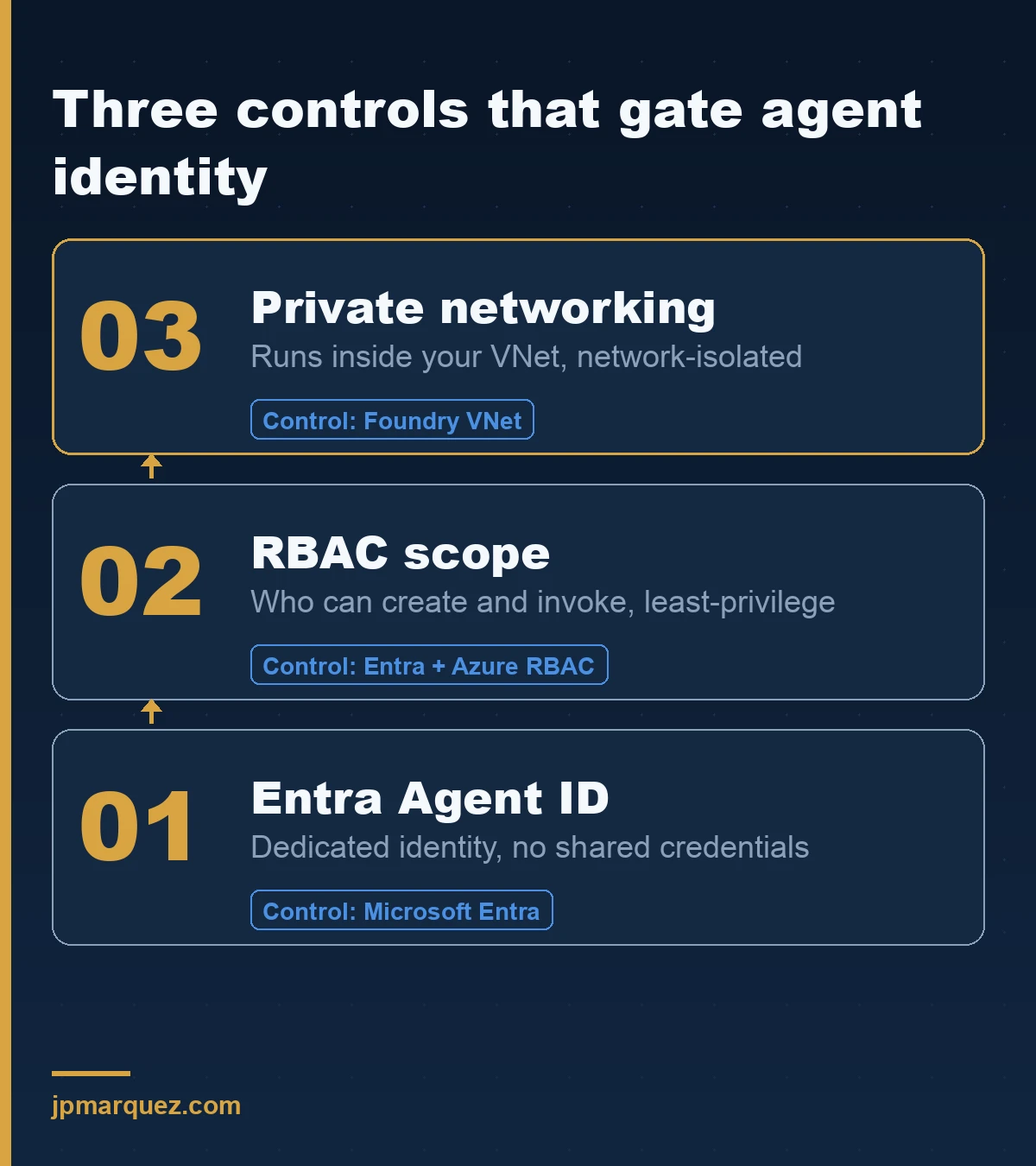
In a demo, the agent runs as you. In production, that's a security incident waiting to happen. Gate 3 is about giving the agent a first-class, governed identity of its own — because an agent that acts takes actions, and every action needs an accountable actor behind it.
Foundry Agent Service supports a dedicated Microsoft Entra Agent ID per agent: scoped, least-privilege access to resources and APIs without sharing credentials, with the ability to authenticate to external tools and pass identity through on-behalf-of flows. Combined with role-based access control and private networking that keeps the agent inside your virtual network for data-residency compliance, this is what turns an agent from a script running with someone's borrowed token into a governed workload.
I've written separately on why agent identity is the control plane as agents start to outnumber human users. The short version for this gate: if you can't answer "what identity did this agent act under, and what was it allowed to touch?", you are not ready for production, no matter how good the answers are.
Gate 4 — Can you measure quality before and after you ship?
You cannot manage what you don't measure, and you cannot ship a non-deterministic system on vibes. Gate 4 requires an evaluation harness: a way to score the agent's behavior against a test set, establish a baseline, and set a threshold it must clear.
Foundry provides built-in agent evaluators that function like unit tests for agentic systems — they take agent messages and return pass/fail scores across two dimensions: system evaluation (did it complete the task, resolve intent, satisfy the user?) and process evaluation (did it call the right tools, adhere to its instructions, navigate efficiently?). The Azure AI Evaluation SDK lets you set an explicit acceptance bar — Microsoft's own example is an 85% task-adherence passing rate — before release. Then you wire it into the pipeline: evaluation as a quality gate in CI/CD via GitHub Actions, so a regression fails the build instead of reaching users.
The mindset shift here is the whole point of the gate. Evaluation isn't a one-time pre-launch checkbox; it's a regression suite you run on every change to the prompt, the model, or the tools. Ship without it and your first sign of a quality regression will be a user complaint, which is the most expensive possible detector.
Gate 5 — Can you see what the agent did in production?
The final gate is observability, and it's the one teams most often defer — right up until the first incident, when they discover they have no idea what the agent actually did. Non-deterministic systems can't be debugged by reading the code, because the code didn't decide the behavior; the model did, at runtime, with inputs you didn't see. You need traces.
Foundry stores traces in Application Insights using OpenTelemetry conventions, and server-side tracing turns on automatically once you connect an Application Insights resource — no code changes, traces within minutes. Each trace lets you step through every span: the reasoning, the tool calls, the retrievals, the latency, the exceptions. On top of that, continuous evaluation samples live production interactions and scores them for quality and safety in near real time, so quality drift surfaces on a dashboard instead of in a postmortem.
The test for Gate 5: when someone reports "the agent gave a wrong answer to a customer this morning," can you pull that exact conversation, see every step it took, and explain the failure by lunch? If the honest answer is "we'd have to guess," you have a demo in production, not a production system.
Only after Gate 5 does publishing become a formality rather than a leap. Foundry's built-in versioning and publishing gives you snapshotted versions, rollback, and a stable managed endpoint — so promotion is a controlled release, and if something's wrong, you roll back to a known-good version instead of scrambling.
A pattern from the field
On a three-day Agent Factory engagement for a large international NGO, the team came in convinced the hard decision was choosing between three agent platforms. It wasn't. When we scored the actual use case, the honest signal was that the winning path reused foundations they'd already deployed — an existing identity model, an existing data estate, existing monitoring. The "platform decision" everyone was bracing for turned into a stack decision, and it stopped being a fight.
That reframing is the practical heart of this framework. The customer's instinct was to ask "which platform is best?" The better question — the one that actually predicts whether an agent reaches production — is "what's already deployed and governed that this agent can stand on?" The agents that sailed through these five gates were the ones reusing existing foundations. The ones that stalled were the ones treating every gate as greenfield. Reuse is the quiet quick-win signal, and almost nobody names it out loud.
Frequently asked questions
How long should the pilot-to-production transition take?
Less time than the pilot if you reused existing foundations; a full program if you're building identity, data governance, and monitoring from scratch. That's exactly what Gate 1 through Gate 5 are designed to reveal early — so you price the work honestly instead of discovering the cost after you've promised a date.
Do I need Azure AI Foundry, or can I do this in Copilot Studio?
Both support all five gates; they express them differently. Copilot Studio abstracts more (moderation, grounding, and identity are more built-in), which suits business-led agents. Foundry Agent Service gives you finer control over models, tools, evaluation, and networking, which suits engineering-led agents with stricter requirements. Many enterprises run both — see when to use which.
What's the single most-skipped gate?
Gate 5, observability. Teams treat it as operational overhead to add later, then hit an incident with no traces and no ability to explain what happened. Connect Application Insights before you go live, not after — it's automatic and there's no excuse to defer it.
Is evaluation really necessary for a simple internal agent?
Yes, proportionally. A simple agent needs a small test set and a clear pass threshold; a complex one needs continuous evaluation on live traffic. What no production agent can skip is some objective measure of quality, because "it seemed fine in testing" is not a baseline you can defend when it regresses.
How does this relate to normal application lifecycle management?
It's an extension of it, not a replacement. Everything you already do — environments, pipelines, managed solutions — still applies; see Copilot Studio ALM. The five gates add the agent-specific concerns (grounding, agent identity, non-deterministic evaluation, agent tracing) on top of the ALM discipline you should already have.
The bottom line
The distance between a pilot and production isn't capability — it's reliability, and reliability is built from unglamorous machinery: narrow scope, permission-aware grounding, governed identity, objective evaluation, and real observability. Microsoft gives you first-class tools for all five gates. The framework's job is simply to stop you promoting a demo before it's earned each one. Run your current agent through the five gates honestly. The gate it fails is the work you were about to skip.